2000
"And The Wall Came Tumbling Down in Los Angeles," in Joseph Bernt and
Marilyn Greenwald, eds., The Big Chill: Investigative Reporting
in the Current
Media Environment (Ames: Iowa State University Press) looks at the
elimination of the "Church/State Wall" between editorial and advertising
functions at the Los Angeles Times as ordered by Mark Willes, who
was Times Mirror CEO and briefly Times publisher. Willes lacked
any journalism experience, being a Ph.D. in economics, a former banker
and university professor, and most recently vice-chairman of General Mills,
which makes Cheerios and Hamburger Helper. The resulting partnership between
editors and advertising sales staff resulted in thinly-veiled promotion
appearing on the pages of the once-respected daily in the guise of news
stories and led to a revolt by journalists. The Big Chill was honored
in 2001 with an award by the Society of Professional Journalists.
2001
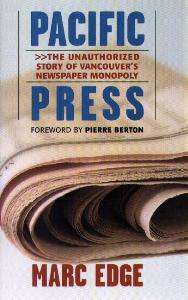
Pacific Press: The Unauthorized Story of Vancouver's Newspaper Monopoly
(Vancouver: New Star Books) is a history of the joint-operating Vancouver
Sun and The Province. The book traces the creation of Pacific
Press from the handshake agreement between Sun publisher Don Cromie
and Southam executive St. Clair Balfour in a fishing skiff off the west
coast of British Columbia in the summer of 1956 to the Sun's move
from afternoon to morning publication in 1991. Here are
some excerpts from Pierre Berton's foreword: “Marc Edge's fascinating study
of the rise (and fall) of Pacific Press is invaluable. . . . Edge has filled
in the blanks and provided the details for future historians who chronicle
the newspaper world of the twentieth century. . . . Most important, however,
Edge's carefully researched investigation provides a case study of that
flawed concept the business world calls ‘synergy.’”
Here are what the reviewers are saying:
“Edge succeeds in capturing with precision the past 44 years of B.C. newspaper history. . . . A comprehensive must-read for anybody interested in the history of B.C.’s print media. After reading Pacific Press and digesting its exploits, never again will the front pages of the Vancouver Sun or the Province look the same.” Brian Liu, UBC Thunderbird online journalism review Read the full review
“Marc Edge, a former Province staffer, has turned his PhD dissertation on Pacific Press into that rarest form of scholarship: a compelling read. . . . Edge brings to life the smoky newsrooms, bitter labour disputes, and eccentric characters that dominated the times.” Devan Crawley, Quill & Quire Read the full review
“It’s a bit of everything: academic dissertation (which is what it started out as), tribute to old-school journalists, number-crunching case study, and anticorporate polemic.” Frank Moher, The Georgia Straight Read the full review
“Despite his two graduate degrees, Marc Edge is still at heart the Vancouver journalist who worked at The Province from 1974 until leaving 'in exasperation' in 1993 to pursue an academic career. He still loves to tell a good story, and plenty of rollicking newsroom tales have been imported into this book . . . A must-read for every student of mass communication in Canada, a fascinating read for journalists and other professional communicators and, in selected chapters, a lively revelation of newsroom personalities and practices for anyone who loves newspapers.” Peter Desbarats, Vancouver Sun Read the full review
“You must read Pacific Press, a brilliantly researched history of the company, by former Province courthouse reporter Marc Edge. I love the book.” Denny Boyd, B.C. Business Read the full review
“Another excellent book . . . explaining how Southam, despite owning
both of Vancouver's papers, somehow couldn't make them consistently profitable.”
Allan Fotheringham, Maclean’s Read
the full review
“Marc Edge and his editors at New Star have accomplished one of the
most difficult feats in book publishing: transforming an academic thesis
into a bona fide page-turner. If you have any interest at all in the hothouse
world of the Vancouver media, you will enjoy this gossipy history of the
city's newspapers.” Dan Francis, editor, The Enclyclopedia of British
Columbia Read
the full review
“Any resemblance this work has to a thesis is purely coincidental.
In many ways, it is quite light reading making no pretense that it is in
any way an in-depth scholarly study. . . . What follows in short, thematic
chapters is a tale of corporate intrigue, labor malpractice, and a defiance
of Canada's competition rules. For any one who enjoys shenanigans in high
places, the book is a must.” David R. Spencer, Journalism and Mass Communication
Quarterly Read the full review
“Not a neutral analysis, as is obvious from its self-proclaimed status
as an ‘unauthorized’ history. . . . Edge’s criticisms leave the reader
wondering what the managers, owners, and editors would say in reply. In
any case, readers can still learn from the historical facts collected in
this volume, while making up their own minds about the author’s judgments.
A more balanced view of the legacy of Pacific Press will have to await
other histories with other perspectives.” Stephen Ward, Journalism History
Read the full review
“Edge’s book makes a major contribution to the field. . . . Original,
thorough and provocative, Pacific Press sets a high standard. . . . with
its even-handed analysis of the emotion-arousing issues.” Maxine Ruvinsky,
Textual Studies in Canada. Read the full
review
“Well written and engaging . . . . meticulously researched. . . . almost as interesting and quirky as the company itself. . . . Each chapter is a pastiche of people and events. . . . [and] also sketch out a pattern of large egos and small minds. . . . one of the genuine strengths of Edge's book is that it portrays Pacific Press as a place that defies easy answers or simplistic explanations.” Catherine McKercher, Canadian Journal of Communication. Read the full review
“A definitive addition to the history of the media in Canada. . . . Edge convincingly outlines the interplay of economic, institutional, and labour forces . . . and their impact on content, circulation, and the larger media culture. . . . Fascinating. . . . His use of sources -- both interview and document material is meticulous, as is his eye for detail and story -- is an obvious remnant of his journalistic experience. . . . A must read and his argument that the numerous strikes and shutdowns coupled with the lack of competition in the market have left Vancouver readers unattached and underserved is convincing.” Mary Lynn Young, Labour/Le Travail. Read the full review
“[An] ambitious study. . . . a big, vibrant, interesting book. . . . complex and densely written. . . . Edge tells a story that needed to be told. . . . Marc Edge is a voice for those who think sanity and good business lie [in] compromise and clear talking, not programmatic and hypocritical dogma.” Gerry Hopson, B.C. Book World. Read the full review
“Edge raises important, universal questions about the political economy of the North American newspaper industry, and the impact of corporatization and bottom line thinking on dailies, journalists, other press workers, and readers. As Edge amply illustrates, what happened to Vancouver's once proud newspapers is a legacy of this trend,” Barbara M. Freeman, American Journalism. Read the full review